Thursday, June 25, 2009
Carpinus

Tuesday, September 16, 2008
Tropical

Some people are uneasy with this. I hear people express a categorical preference for hardy perennials, implying they are somehow classier. Even among permissive gardeners, there is a sense that some tropicals are suitable bedding plants and some should stay inside. But that prejudice seems to be lifting, and more and more I notice monstera, crotons, asparagus ferns, colocasias and wandering jew planted with the familiar tender annuals in our summer gardens.
In New York, with our torrid summers and reliance on container gardening, these alien plants really contribute. They are a horticultural match of the city’s human diversity.
Still there’s a time and place for everything, and I don’t think I’d work a Monstera into rose garden. For the most part they belong in containers near the house. If you have the space and winter sun, you can haul them in when the time comes.
Wednesday, August 6, 2008
Feral petunias
I think these wildlings can carry on like this, reseeding for years. They aren’t really a substitute for garden petunias, but in their way, they are splendid.
Four-o-clocks, nicotiana, cleomes and verbena: All are tropical annuals that seem to perpetuate themselves by seed.
Monday, June 9, 2008
Chinese
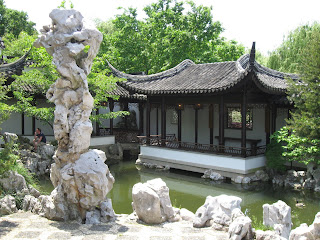
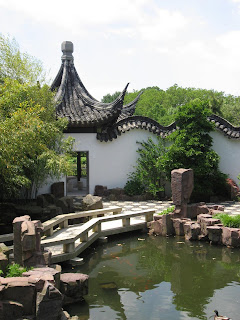
I visited the Chinese Scholar’s Garden at the Staten Island Botanical Garden, and what a treat it was. The garden opened in 1999, and the planting is now mature.
This garden was designed and “built” (as they say of Chinese gardens) by the Landscape Architecture Corporation of China, an entity with ties to the Chinese government:
http://lac.com.cn/
Materials, workmen and expertise were all imported from China, and the results are as authentic as you could reasonably hope for. The same outfit built Astor Court at the Metropolitan Museum.
The garden was intended to be a “standing cultural ambassador” of China. I wish more countries would adopt this policy, especially France, Iran, Spain, Italy, Brazil and the Netherlands. China aced this one.
I love Chinese gardens and wish they were more influential. Westerners have been preoccupied with upturned eaves and scholars’ rocks and overlook the brilliant planning and sophisticated handling of light, space and sound. These aspects of Chinese gardens transcend chinoiserie:
1) The gardens are private, walled sanctuaries. Their relation with the world outside is minimal. Within the walls is perfected world where people live in harmony with nature. Everything within is imagined.
2)The gardens aspire to the state of landscape painting. Impressions of scenery – usually mountains and rivers – are created. (But the scenery need not be a Chinese landscape of misty mountains; it could be any vision of paradise: a salt marsh, a woodland, or a dream of Claude.)
3) Architecture is integral to the concept. As at the Alhambra or Vaux, pavilions, paving, steps, walls and pools make the bones of the garden, and these structures make a place for humans in the envisioned paradise.
4) Space and light are handled to suggest infinity. For example, a pavilion built at the edge of the garden would not be built against the outside wall. A narrow courtyard, just a slot, is left between the outer wall and the pavilion. This admits light to the back of the pavilion, and by thoughtfully planting the courtyard and placing windows in the pavilion and outer wall a layered stage scenery is created – the illusion of depth conveyed in 3 feet of space.
5) Great attention is paid to all the senses. Sounds and echoes, the feel of cobbled paths underfoot, the alternation of dim and bright spaces, dark waters and bright, scents.
6) Opportunities for seclusion, evasion, retreat and secret assignations abound.
I long to build myself a garden based on these principles in a tough, low rise, built up area, like Bushwick. I would abstain from details in the Chinese manner, and build it in plain construction of the local type. The pavilions would be adapted for the needs of my life: a public room for entertaining, a library, a kitchen and dining room, a bedroom, a bath. The remainder of the garden would be mostly water, with a limited number of my favorite plants, and all my attention directed at managing light, shade and reflection. From the street it would look like the adjacent buildings and go unnoticed.
Thursday, April 24, 2008
Better than Forsythia Part 2

Still I stand by my disapproval of planting Forsythia in Brooklyn.
But say you are planting a typical Brooklyn garden, and you love Forsythia because it’s bright and early. Corylopsis (recommended after the last Forsythia tirade) is too wan and toned-down for your taste. What you want is uninhibited brassiness to go with the tulips and flowering cherries.
So plant Kerria. It’s resoundingly yellow, and, unlike Forsythia, the flowering repeats a little after the initial flush. Dirr says it’s “ideally sited in partial shade.” The leaves are neat, and the stems are distinctly green and ornamental in winter. The photo shows the double flowered variety, which is more common than the more elegant single.
Monday, April 14, 2008
Ruderal

The gist of his lecture is that urban environments create horticultural conditions (disturbed, compacted soils, expanses of pavement, urban heat island warming, etc.) that support a distinct community of plants. Cosmopolitan in origin, these plants are largely reviled as weeds: ailanthus, black locust, mugwort, bindweed, chicory. We struggle to eradicate them; even legislate against them. Instead we might recognize their possibilities for the ruderal landscape.
(Learning the word “ruderal” was worth the trip up there: “growing in rubbish, poor land, or waste places. From Latin rudera, ruins, rubbish, plural of rudus, broken stone.”)
Del Tredici is working on a book, Wild Urban Plants. It goes to the publisher in October. It sounds like Weeds of the Northeast, horticulturally considered. I look forward to seeing it.
There is a lot wishful thinking about native plants: You can earn a LEED credit by planting a community of natives on imported soil and handing it over to the maintenance man to nurse. I don’t want to discourage well-meaning gestures, but it’s hard to see how this kind of planting accomplishes much in the way of plant conservation. (What is actually needed is a whole preserved ecosystem where the plants can endure in a community of organisms they evolved with – something beyond the purview of green building.)
For urban planting we might look instead to these ruderal “natives” that are so well suited to the actual growing conditions. Del Tredici has planted meadows of yarrow, chicory, goldenrod, and bouncing bet. And the black locust is as fine a tree as grows.
I’d be interested to know if the planting schemes for the High Line consider this line of thinking. Ruderal natives are growing there already.
