Showing posts with label spring. Show all posts

Monday, April 13, 2009

spring and all


This is going to look a mess in a month, but now, it's heaven. These daffs, muscari and phlox are nicer in a grassy meadow than a tidy mulched bed.

Monday, March 16, 2009

English


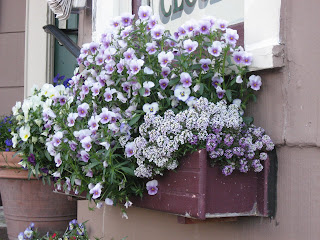
I think of April, May and June as the English season in New York gardens. In the cool sunny days early flowers like violas, pansies, ranunculus, primrose and alyssum bloom in dizzy profusion. These, combined with flowering shrubs and roses, are our opportunity to have an "English garden" that will soften the heart of a minimalist -- if he admits it or not.

So go for it. Plant window boxes with violas and alyssum. (I took this picture last month in Pacific Grove, California, where they have English weather year round.) Time is short, only a couple of months before hot weather comes. Then the cool season flowers flag and it's on to tropicals that the English envy us for.

Besides, you can't plant impatiens yet. It's pansies or nothing.

Tuesday, April 29, 2008

Higan


Having dissed the flowering cherries I have to put in a word for the Higan cherry, Prunus subhirtella pendula. It is really something, like a ruined cathedral hung with candyfloss.

Like most pendulous trees, it looks at home near water. I could also imagine it hanging above a steep ravine.

Taste


This spring I studied the flowering cherries. I thought I should get some clear ideas about them because, in my head, the varieties mostly run together.

Then the crabapples bloomed. What a relief to be able to let go of the cherries and just enjoy the crabs. Their fragrance is as fine as the lindens, and it’s as free. In many crabs the buds are deep pink, but when the flowers open, they are white. I keep an eye on the crabapples for the day when the two-tone effect peaks.

The cherries bore me, but the crabs are a delight. I don’t know why. The extravagance of both is comparable. And objectively, most of the cherries are better garden trees: they have a tidy habit compared to the crab’s awkwardness, more disease resistant foliage, better bark and fall color. But the blooming crabs, especially the straight species Malus floribunda, are a high point of spring for me.

I think knowledge and involvement with plants only serves to sharpen these kinds of preferences. And it’s a good thing. Preferences should be exercised. Gardens holds together when there is an abiding taste behind the thousand choices that guide their creation. They go wrong when they try to have a little of everything.

Monday, April 21, 2008

Ephemerals


I Iwas lucky to see this patch of Bloodroot. The flowers are so fragile they last only a few days -- even less in the warm weather we’ve had. So I saw this bunch at its absolute zenith.

These fiddleheads (I think they belong to the Cinnamon Fern) are covered in astonishing soft fuzzy jackets. I’ve never seen anything like it. The next day, the fuzz had broken apart and fell like rags off the unfurling fiddlehead.

Washtub Azalea


Nobody fusses over this azalea, but it's been comfortable and thriving for many years. It grows in about 8 inches of soil in a galvanized washtub. Over the years a layer of decaying leaves has accumulated – I venture that is all the feeding the azalea gets. The washtub sits in front of a south facing house, shaded by a Zelkova tree.

The plant is perfectly suited to its situation so it really can thrive on neglect.

This is one of my favorite azaleas, a Kurume hybrid called ‘Coral Bells’. Its small, beautifully formed blossoms are a good, strong, warm pink. The color is about as intense as I like to see in April.

Thursday, April 10, 2008

Better than Forsythia


Better than Forsythia

The Forsythia is honored April 6 at the Brooklyn Botanic Garden with plants given free to garden members. It’s a point of local identity: In 1940 a garden benefactor, Mrs. Edward C Blum, was instrumental in having forsythia declared the official flower of Brooklyn. It was “…imbued with a message of brotherhood, unity and understanding…” she said.

Forsythia is at its best grown in full sun and allowed to develop into the fountain shape it naturally assumes. The usual cultivars are in the 8 foot by 8 foot range -- too big for most Brooklyn gardens -- so they are routinely hacked with hedge trimmers into manageable shapes. Treated thus they bloom poorly; and because Forsythia is undistinguished after its April bloom, it becomes an eyesore. You see these sad plants all over the borough.

If you must have Forsythia, be sure you have a sunny spot, pick a cultivar suited to the space to have, and prune it by removing entire old branches at their base. Smallish cultivars like ‘Gold Tide’ are better suited to most Brooklyn gardens. There’s one called ‘Bronxensis’ that’s smaller still, practically a ground cover.
If your garden is shaded at all, I recommend you forego Forsythia entirely and grown another east Asian shrub, Corylopsis pauciflora, the Buttercup Winterhazel. It blooms with the forsythia and hangs its pale yellow flowers like bells from the twigs. This poised 4 to 6 foot shrub is better suited to city gardens. Its neat foliage colors gold in autumn.

Spring and All


This is Crocus tomasinianus. Brent and Becky's Bulbs has them for $220 per 1000. They seed and increase if you put off mowing the lawn